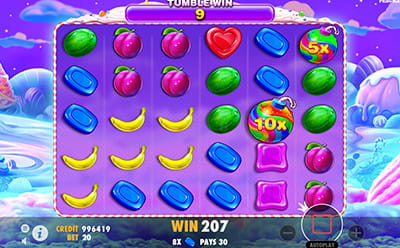
Multiplier bombs are one of the most misunderstood parts of Sweet Bonanza. They do not apply to every winning spin, and they are not a permanent boost to the game’s ordinary symbols. In the original version, they appear only during Free Spins and interact with the Tumble mechanic in a specific way. Players comparing a sweet bonanza casino option should therefore read the loaded game’s information panel rather than rely on a general description, because settings and feature availability can differ between operators.
When can multiplier bombs appear?
The multiplier feature is restricted to the Free Spins round. It does not operate during ordinary paid spins, even when a winning combination creates several consecutive tumbles. This distinction matters because the base game can look highly active: winning symbols disappear, replacement symbols fall into the empty spaces, and further combinations may form from the same paid spin. That activity does not mean a multiplier is available.
Free Spins begin when at least four lollipop Scatter symbols land. In the original rules, the feature normally starts with 10 spins. Three or more additional Scatters during the bonus round award five extra spins. The number of spins and the retrigger condition belong to the game’s built-in feature, while promotional free spins offered by a casino are a separate matter governed by that casino’s terms.

During an eligible Free Spin, bomb symbols can appear on the grid alongside the ordinary fruit and candy symbols. Each bomb carries a random value from 2x to 100x in the documented version. A bomb is not itself a guarantee of a win, nor does seeing one mean the entire spin receives that value. Its role is determined by what happens in the current Tumble sequence and whether that sequence produces a payable win.
How does the multiplier calculation work?
The calculation follows the order of events on the grid. First, matching symbols create a win under the Pay Anywhere system. A qualifying combination requires at least eight matching paying symbols anywhere on the 6×5 grid. Winning symbols then vanish, the remaining symbols drop, and new symbols enter from above. This process continues while each new arrangement produces another winning combination.
Bombs that appear during this activity remain on the grid until the current Tumble sequence has finished. Their values are then added together. For example, if one sequence contains bombs marked 2x and 10x, the feature uses a combined 12x multiplier for that sequence’s tumble win, subject to the game’s own calculation rules. The important point is that the values are accumulated rather than applied as unrelated multipliers to separate symbols.
The combined value applies to the win produced by that Tumble sequence, not automatically to every win in the complete Free Spins round. When the sequence ends, the next Free Spin begins under the same general rules, but its bombs and winning symbols must be assessed independently. This is why a visible bomb can remain inactive in practical terms if the surrounding arrangement does not create a payable tumble win.
What happens when several wins share one tumble?
More than one symbol group can win during the same tumble sequence. The game adds the relevant wins from that sequence before applying the accumulated bomb value. This prevents the feature from being understood as a simple “one bomb, one symbol” mechanic. The multiplier is connected to the sequence-level result, while the qualifying wins arise from the matching symbols that appear across its stages.
Consider a Free Spin in which an initial arrangement creates a fruit win, then the replacement symbols produce a second candy win. If bombs have appeared and remain present through those stages, the game can treat the combined tumble result as the amount affected by the accumulated multiplier. The exact visual presentation may vary between casino interfaces, but the underlying principle is that the active sequence is settled before the next independent spin starts.
This structure also explains why a long cascade can be more important than a single large symbol group. Each additional tumble gives the grid another opportunity to form matching symbols while the sequence remains active. However, it does not remove the game’s volatility or guarantee that the next arrangement will win. A player should judge the feature by its rules, not by assuming that every extra drop increases the result.
Which limitations should players check first?
The first limitation is configuration. The casino hosting the game controls which version is loaded, including the applicable RTP setting, stake denominations and whether particular options are enabled. Published RTP figures for the original version have appeared around 96.48% to 96.51%, but that range should not be treated as universal. The in-game information screen is the more relevant source for the specific version being played.
The second limitation is availability. An operator may disable features such as Bonus Buy or the Ante Bet option, and local rules can also affect what is offered. Bonus Buy, where permitted, is distinct from the multiplier feature: it may purchase the 10-spin Free Spins round for 100 times the selected base bet in the documented version. That price and availability must be confirmed in the loaded game rather than assumed.
The third limitation concerns expectations. A multiplier from 2x to 100x does not describe a guaranteed return, a fixed prize or a predictable frequency. The game’s maximum-win figure, RTP and multiplier range are mathematical characteristics of a configuration, not promises about an individual session. For broader Canadian information about gambling risks and support, readers can consult Canada’s responsible gambling information.
How should the feature affect a play decision?
Begin by opening the information panel before choosing a stake. Confirm that the loaded title is the original version rather than a later release with a similar name, such as a Super Scatter, 1000, 2500, Xmas or POP edition. Check the displayed RTP, bet range, maximum win and the rules for Free Spins. Similar branding does not mean identical mechanics or probabilities.
Next, separate game decisions from casino decisions. The slot determines how Tumbles, Scatters and bombs operate, but the operator determines account requirements, bonus conditions, transaction rules and responsible-gambling controls. If promotional funds or free spins are involved, read the relevant terms carefully: wagering requirements, maximum-bet rules, expiry periods and game contribution are not part of the standard multiplier calculation.
Finally, set a fixed entertainment budget before playing and avoid treating a large multiplier as evidence that another one is due. A demo mode can help someone understand the sequence of drops and the appearance of bombs, but it cannot verify the RTP or predict real-money results. If the feature’s conditions, configuration or cost are unclear, pause and check the operator’s stated information before continuing.
Questions players often ask
Do multiplier bombs appear during regular spins?
No. In the original rules, multiplier bombs appear only during the Free Spins feature. Ordinary paid spins can still produce Tumbles and several consecutive wins, but those wins are not enhanced by the Free Spins bomb mechanic. The precise loaded version should always be checked through its in-game information panel.
Are two bomb values multiplied together?
They are added together within the active Tumble sequence. For instance, 2x and 10x produce a combined 12x value for that sequence under the documented rules. The result is not normally treated as 20x. The sequence must also produce an eligible win before the accumulated value has practical effect.
Does one multiplier apply to the whole bonus round?
No. Bomb values relate to the current Tumble sequence, not automatically to every Free Spin that follows. Once that sequence ends, its accumulated value is settled. A later spin begins separately, with new symbols, new possible bombs and a new result. Retriggered spins do not inherit an earlier sequence’s multiplier.